 English
- Home
- About Company
- Our Products
- Pneumatic & Hydraulic Fittings
- Hoses & Hose Clips
- Lifting Products
- Pipe & Pipe Fittings
- Industrial Valves
- Rubber Products
- PTFE Teflon Products
- Tools & Welding Accessories
- Adhesive Products
- Fasteners
- Gasket Sheet
- Transmission Products
- Gland Packing
- Cut Gasket & Spiral Wound Gasket
- Champion Gasket Sheet
- Anti Vibration Mount
- Flexible & Rigid Coupling
- Brochure
- Gallery
- Contact US
Industrial Valves
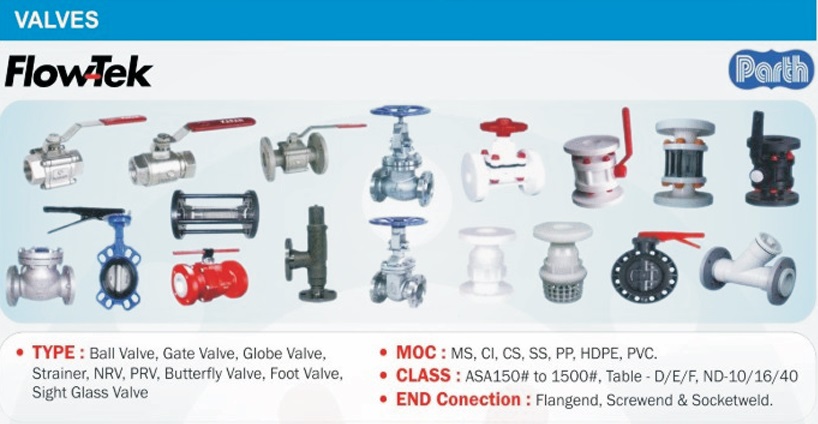
Industrial valves are mechanical devices that control the flow, pressure, and temperature of liquids, gases, or solids in systems and processes. They can open, close, or partially block passageways. Industrial valves are used in a wide range of industries, including chemical, petroleum, natural gas, electric power, metallurgy, pharmaceuticals, and food.
Here are some characteristics of industrial valves:
-
Design
Industrial valves come in many shapes and sizes, and can be simple or complex.
-
Components
Most industrial valves have the same basic components: a body, bonnet, actuator, valve member, and seat.
-
Materials
Industrial valves are made from a variety of materials, including aluminum, plastic, and stainless steel.
-
Actuators
Actuators are used to actuate the valve. Common actuators include air cylinders, gears, electric motors, and solenoids.
-
Types
Some common types of industrial valves include globe, butterfly, plug, and gate valves.
Some examples of industrial valves include:
-
Globe valves
These linear motion valves use a globe-shaped disc to regulate flow. Water faucets are an example of a globe valve.
-
Butterfly valves
These valves have a disk that sits in the middle of a pipe and can swivel to admit or block fluid flow.
-
Plug valves
These valves use a cone-shaped plug that moves aside when the handle is turned.
-
Gate valves
These valves open and close pipes by lowering metal gates across them. They are often used for wastewater applications and neutral liquids.
-
Check valves
These non-return valves prevent fluids from flowing backward.
-
Backflow preventers
These are a module assembly of check valves that are used in high-hazard environments.