 English
- Home
- About Company
- Our Products
- Pneumatic & Hydraulic Fittings
- Hoses & Hose Clips
- Lifting Products
- Pipe & Pipe Fittings
- Industrial Valves
- Rubber Products
- PTFE Teflon Products
- Tools & Welding Accessories
- Adhesive Products
- Fasteners
- Gasket Sheet
- Transmission Products
- Gland Packing
- Cut Gasket & Spiral Wound Gasket
- Champion Gasket Sheet
- Anti Vibration Mount
- Flexible & Rigid Coupling
- Brochure
- Gallery
- Contact US
Pneumatic & Hydraulic Fittings
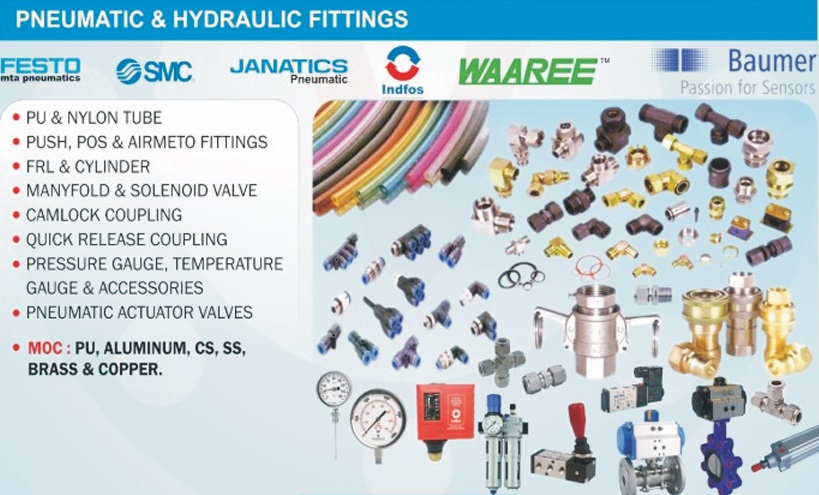
Pneumatic and hydraulic fittings are used to create systems that move liquids, gases, and other substances. The main differences between the two types of fittings are the medium used and the applications they are used for:
-
Pneumatic fittings
These fittings are used for environments that require clean, safe, and precise control with lower force. Pneumatic fittings are less complex than hydraulic fittings, and are often push-in fittings that can be easily attached or removed by hand.
-
Hydraulic fittings
These fittings are used for applications that demand high power, durability, and consistent force application. Hydraulic fittings are typically crimped or swaged and are permanently attached to the pipe using a special tool. The end fittings of a hydraulic hose assembly are normally threaded or flanged.
Here are some other things to consider when using pneumatic and hydraulic fittings:
-
Materials
Brass is an alloy that can handle higher pressures and temperatures than plastic, and is resistant to saltwater corrosion.
-
Connection types
Some common connection types for hydraulic fittings include NPT (National Pipe Tapered) and BSPT (British Standard Pipe Tapered).
-
Seal types
O-Ring Face Seal (ORFS) fittings are ideal for high-pressure applications and provide a leakage-free connection.